An ISP, or Internet Service Provider, is the company that connects your home, your business or your mobile to the Internet network.
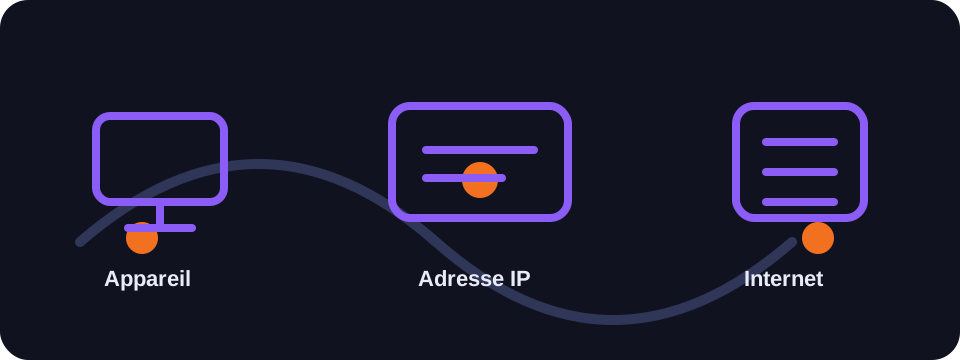
Key takeaways
- The ISP generally assigns your public IP address.
- It carries your data between your network and the Internet.
- It can provide DNS, router, telephony, TV or business services.
- A VPN can limit what your ISP sees of your browsing.
Definition and role
The ISP is the technical intermediary between your device and the rest of the Internet. It operates or rents network infrastructure: fibre, ADSL, cable, 4G, 5G, routers, collection equipment and international connections.
Major ISPs vary by country. Other players exist for businesses, hosting, specialised networks or local areas.
How does the connection work?
When your router connects to the operator's network, it receives a configuration: IP address, gateway, DNS and routing parameters. Your traffic then passes through the ISP's infrastructure before reaching the requested servers.
The ISP may also use technologies such as CGNAT to share an IPv4 address between multiple customers, or offer IPv6 to provide more addresses.
What your ISP can see
Your ISP knows your subscription, your billing address, your assigned IP address and certain connection metadata. With HTTPS, it does not see the exact content of the page visited, but it can sometimes observe the domains contacted depending on the DNS configuration.
A VPN encrypts the traffic between you and the VPN server. The ISP then mainly sees a connection to that server, but not directly the sites visited thereafter inside the tunnel.
Conclusion
The ISP is a central player in your Internet access. Understanding its role allows you to better read the ISP data displayed in an IP lookup tool and to know what a VPN or alternative DNS can really change.
How to use this guide in practice
To use this guide on ISP information reliably, start by checking the context of your connection: home network, mobile network, company network, VPN, proxy or server. The same result can mean different things depending on the exit point being used. IP information should therefore be read together with other clues, such as provider, ASN, country, address type and DNS settings.
Avoid jumping to conclusions. Many network data points are approximate, shared or dependent on a third-party provider. If you are troubleshooting, note the test time, network used, VPN state and browser involved. These details make comparisons more useful and help separate a real issue from a normal routing effect.
Quick checklist
- Compare the ISP result on two different networks if possible.
- Run the test again after enabling or disabling a VPN, proxy or private DNS.
- Note whether the address is residential, mobile, business, hosted or shared.
- Do not treat an IP address as proof of identity without technical and legal context.
This checklist turns an isolated lookup into a reproducible diagnosis. It is especially useful when two tools show different results or when a service blocks a connection without explaining the reason clearly.
Limits to keep in mind
Results can change over time because of dynamic address assignment, operator routing changes, IP database updates or the use of an intermediary service. A single test is a snapshot of the moment, not a permanent truth.
For a cleaner comparison, repeat the lookup from the same device after changing only one variable at a time. This can be the network, the VPN state, the browser DNS mode or the device used. Changing several variables at once makes the result harder to understand.
FAQ
Do FAI and ISP mean the same thing?
Yes. FAI is the French term, ISP is the English equivalent.
Does my ISP choose my IP geolocation?
Indirectly. Geolocation databases often associate your IP with information provided or inferred from your ISP's network.
Can I change ISP to change my IP?
Yes, changing operator generally changes the IP ranges used, but it is not necessary for a simple IP address change.